
Nepal’s NGO Sector at a Crossroads Amid Shrinking Aid

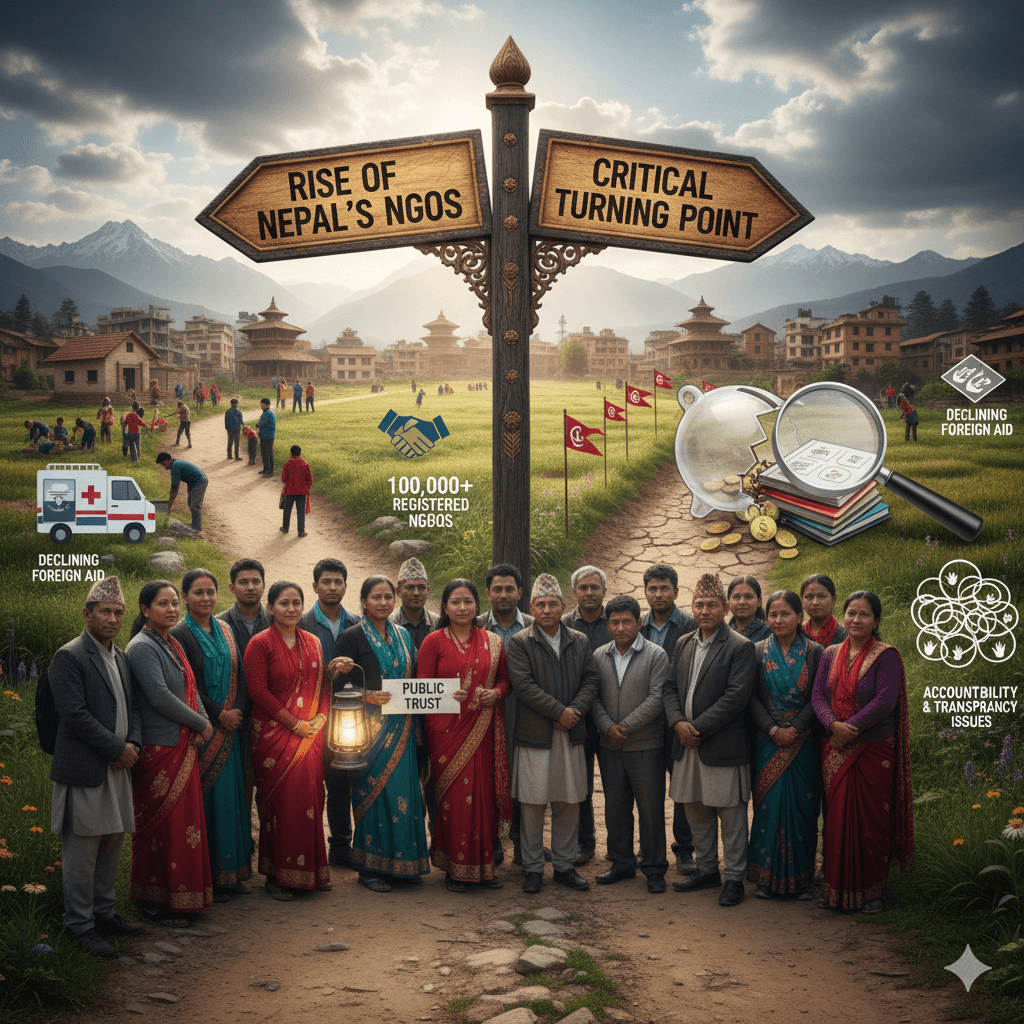
Nepal’s civil society, which flourished after the country’s democratic transition in 1990, is now facing a critical turning point. With more than 100,000 registered NGOs operating across the nation, the sector has been a backbone for social development, education, health, and community welfare. However, a sharp decline in foreign aid and rising public skepticism are threatening the sustainability of these organizations.
The Rise of Nepal’s NGOs
The 1990 democratic transition marked a new era for Nepal, opening doors for civil society to grow. NGOs quickly became vital players in promoting social welfare, advocating for marginalized communities, and supporting government initiatives in areas where public services were lacking. Over the last three decades, Nepal’s NGO sector has expanded exponentially, providing employment, fostering community development, and mobilizing resources for critical issues like health, education, and disaster relief.
Challenges Facing the Sector
Despite their significant contributions, Nepalese NGOs are grappling with several challenges:
-
Declining Foreign Aid
Foreign donors have historically been the lifeblood of Nepal’s NGOs. However, aid inflows have slowed, leaving many organizations struggling to sustain operations. -
Accountability and Transparency Issues
Increasing public scrutiny has highlighted concerns about the misuse of funds, lack of impact measurement, and inadequate reporting mechanisms. -
Competition and Saturation
With over 100,000 NGOs, the sector faces overcrowding, leading to fragmented efforts and reduced efficiency. -
Sustainability Concerns
Many organizations rely heavily on donor funding, making them vulnerable to financial instability when external support declines.
The Need for Strategic Leadership
Experts emphasize that strong leadership and strategic planning are crucial for the sector’s survival. NGOs must:
-
Diversify funding sources, including local fundraising and partnerships with the private sector.
-
Strengthen governance frameworks and promote transparency.
-
Focus on measurable impact and community-centric programs.
The Path Forward
Nepal’s NGO sector stands at a crossroads. Without proactive reforms and renewed public trust, many organizations risk losing relevance. However, this challenge also presents an opportunity: to create a more resilient, accountable, and locally empowered civil society capable of driving sustainable development for years to come.
By embracing innovation, strategic leadership, and stronger accountability, Nepal’s NGOs can continue to play a pivotal role in shaping the nation’s future.
About the Author
Global Touch
Recent Articles
Audit Requirements in Nepal: Ensuring Transparency and Accountability
Oct 31, 2025, 3:49 AM
Finance Management in Nepal: Building Sustainable Business Growth
Oct 31, 2025, 3:48 AM

Understanding Accounting, Finance, Audit, Tax, and Company Registration in Nepal
Oct 31, 2025, 3:45 AM

Deadline Extended for Income Statement Submission
Oct 30, 2025, 1:48 PM
Need Expert Guidance?
Our team of specialists can help you navigate complex financial and regulatory challenges.
Stay Up to Date
Subscribe to our newsletter to receive the latest tax and financial updates directly to your inbox.